

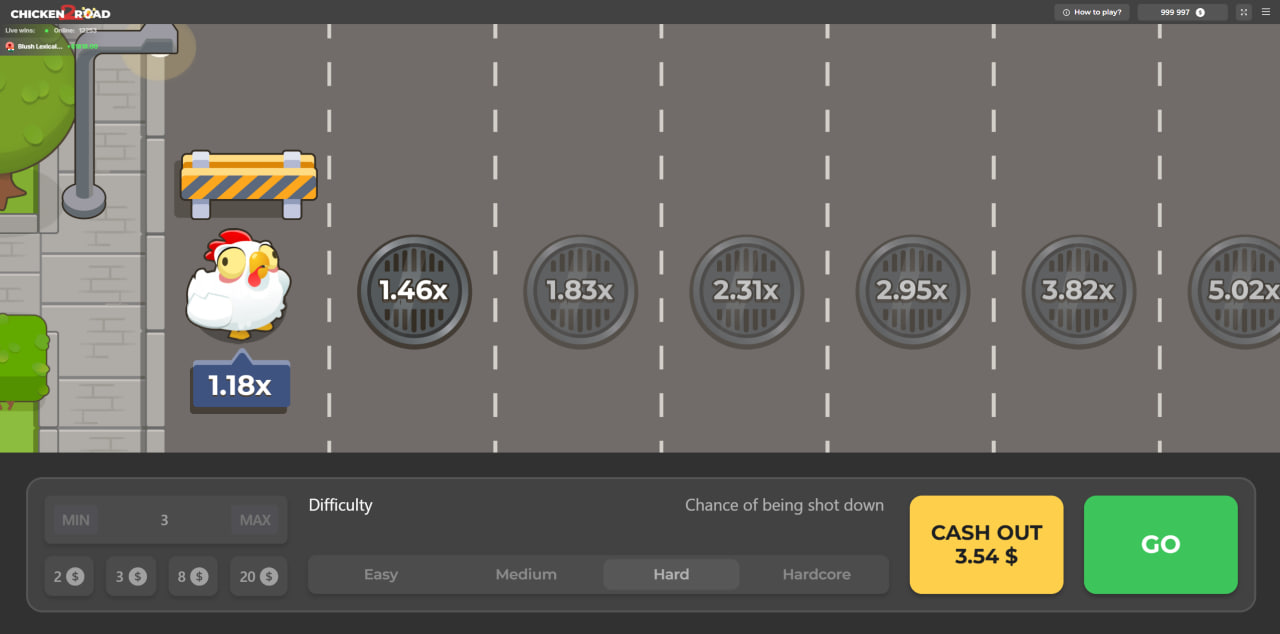
How to Play Chicken Road 2
The full gameplay loop takes under a minute to learn, and the interface reflects that. A bet field sits at the bottom of the screen, difficulty buttons sit above it, and the road occupies the centre of the display. Everything else — balance, history, settings — is secondary.
- Choose your bet. Set the stake for the round. Minimum and maximum values depend on the operator and the account currency, so check the panel rather than assuming a fixed range.
- Select the difficulty. Pick Easy, Medium, Hard and Hardcore before the round starts. The setting cannot be changed mid-round.
- Start the round. Confirm the bet. The stake is deducted and the multiplier display activates at its starting value for that difficulty.
- Move along the road. Advance the chicken one line at a time using the on-screen control. Some versions also support a keyboard shortcut for faster input.
- Watch the multiplier increase. After each surviving step the multiplier updates. The value for the next step is usually shown in advance.
- Decide when to cash out. Between any two steps you can end the round voluntarily and lock in the current multiplier.
- Collect the potential winnings. The payout is your stake multiplied by the value at the moment you cashed out, subject to the platform's maximum win limit.
The only genuinely difficult part is step six. Advancing costs nothing directly but puts the entire accumulated amount back at risk, and the game is designed so that the next step always looks worth taking. Deciding on an exit point before the round starts removes that pressure from the moment when it is hardest to resist.
Choosing the Difficulty Level
Difficulty in Chicken Road 2 gambling game does not change the theoretical return; it changes the shape of the distribution. Lower settings produce many small, frequent cash-outs. Higher settings produce long stretches of lost rounds interrupted by occasional large ones. Both can average out to the same long-run figure while feeling completely different across a hundred rounds.

The number of lines differs by setting. Reported configurations commonly list around 30 lines on Easy, 25 on Medium, 22 on Hard and 18 on Hardcore, though exact values should be checked in the game itself since builds vary between operators. Fewer lines means each individual step carries a larger multiplier increase and a larger chance of ending the round.
| Difficulty | Risk | Potential Multiplier | Suitable For |
|---|---|---|---|
| Easy | Low | Low ceiling, small steady increments | Learning the mechanic, longer sessions, small bankrolls |
| Medium | Medium | Moderate, with noticeably faster growth | Players comfortable with the loop who want balance |
| Hard | High | High, reached over fewer steps | Experienced players accepting frequent losing rounds |
| Hardcore | Very high | Very high ceiling, steep per-step growth | Short, high-variance sessions with strict limits |
Game Features
The feature set is compact by design. Rather than layering bonus mechanics on top of the core loop, the sequel concentrates on giving players control over risk and keeping the round cycle fast.
- Step-based multiplier progression — value accumulates per line crossed rather than on a single random draw
- Manual cash-out at any point — the exit decision stays with the player throughout the round
- Four selectable difficulty modes — risk and reward are configured before each round, not fixed by the game
- Adjustable volatility through those modes — the same title covers low-variance and extreme-variance play
- Provably fair verification — hashed round outcomes can be checked after play on versions that support it
- Free demo mode — full mechanics available with virtual credits on most platforms
- Browser-based delivery — the game runs in mobile and desktop browsers without installation
Nothing here requires a tutorial, which is the point. The features exist to let a player shape the risk profile rather than to add complexity to the round itself.
Updated Graphics and Theme
The presentation is bright, cartoon-styled and deliberately simple. A white chicken stands at the roadside as a single-lane view of moving traffic scrolls across the screen. Vehicles are rendered as flat, clearly coloured shapes so that they read instantly against the road surface. Multiplier values are printed directly on the road ahead, which means the reward for the next step is visible in the same glance as the hazard.
Compared with the original title, the sequel moves the action to a highway-style setting with a denser traffic presentation and a longer visible path on lower difficulties. Animation is limited to what the round needs: the chicken's hop between lines, vehicle movement, and the collision that ends the round. The interface keeps bet controls, balance and cash-out button in a fixed strip so that nothing shifts position mid-round. Whether every visual element counts as an upgrade is subjective, but the layout is noticeably cleaner about separating decision information from decoration.
Adjustable Difficulty and Volatility
Volatility describes how results are spread out rather than how much they average. A low-volatility configuration returns smaller amounts more often; a high-volatility configuration returns larger amounts far less often. In most casino games this profile is fixed by the developer. Chicken Road 2 online exposes it as a setting, which is the single most consequential choice a player makes before the round starts.
This matters for bankroll planning more than for expected return. A stake that is comfortable on Easy can be depleted several times faster on Hardcore, because the proportion of rounds ending with no return is far higher. Matching bet size to the chosen difficulty is more useful than trying to find the mode with the best payout — the theoretical return is the same across settings.
| Difficulty | Volatility | Frequency of Successful Cash-Outs | Typical Session Pattern |
|---|---|---|---|
| Easy | Low | High | Small, regular returns; slow bankroll movement |
| Medium | Medium | Moderate | Mixed results with occasional larger rounds |
| Hard | High | Low | Long losing stretches punctuated by bigger wins |
| Hardcore | Very high | Very low | Mostly losing rounds; rare outsized outcomes |
Chicken Road 2 RTP
RTP stands for Return to Player. It is the percentage of all money wagered on a game that the game is mathematically designed to return to players across an extremely large number of rounds. It is a property of the game's maths, not a promise attached to a session, a day or an account.
The figure is calculated over sample sizes in the millions of rounds. At that scale, individual variance flattens out and results converge on the theoretical value. At the scale an individual player actually experiences — dozens or hundreds of rounds — variance dominates completely, and actual returns can land far above or far below the stated percentage in either direction.
Reported RTP for Chicken Road 2: 95.5%
Implied house edge: approximately 4.5%
Source figures vary slightly between listings (some cite 95.51%). Always confirm the RTP displayed in the game's own information panel on the platform you are using, as configurations can differ between operators.
Chicken Road 2 online is a game of chance, and no RTP figure changes that. Play only with money you can afford to lose, set limits before you start, and treat any return as an outcome rather than an expectation.
What Is the RTP of Chicken Road 2?
The RTP for Chicken Road 2 is widely reported as 95.5%, with some sources listing 95.51%. The remaining share — roughly 4.5% — represents the house edge, which is the structural advantage that makes the game profitable for the operator over time. This is a lower return figure than the one reported for the original Chicken Road, a difference discussed later in this article.
In plain terms, 95.5% means that for every 100 units staked across the game's entire lifetime and all players combined, the design returns approximately 95.5 units. It does not mean you will receive 95.5% of your deposit back. It does not mean a session will end at 95.5% of what you staked. Over a realistic number of personal rounds, the outcome is governed by variance, and finishing with nothing or with a multiple of your stake are both entirely ordinary results.
How RTP Affects Your Results
The gap between theoretical return and personal experience is best seen with numbers. Consider a theoretical model: a player stakes 1 unit per round for 10,000 rounds, wagering 10,000 units in total. At 95.5% RTP, the modelled return across that volume is 9,550 units, with 450 units representing the house edge.
This example is theoretical and illustrative only. It describes long-run mathematical behaviour, not an expected session result.
| Scenario | Rounds | Total Wagered | Theoretical Return at 95.5% | Theoretical Shortfall |
|---|---|---|---|---|
| Short session | 100 | 100 | 95.5 | 4.5 |
| Extended play | 1,000 | 1,000 | 955 | 45 |
| Very large sample | 10,000 | 10,000 | 9,550 | 450 |
The right-hand columns describe the model, not the outcomes. Across 100 rounds, real results scatter widely around that 95.5 figure — a single high-multiplier cash-out can put a player far ahead, and a run of lost rounds can empty a balance regardless of the percentage. RTP becomes visible only at volumes no individual player reaches. It is useful for comparing games, and close to useless for predicting an evening.
RTP Calculator
An RTP calculator converts the published percentage into figures that are easier to reason about. Given a stake and a number of rounds, it estimates the theoretical amount returned and the theoretical amount retained by the house across that volume of wagering. It is a modelling tool, not a forecasting tool.
The formulas:
Total Wagered        = Bet per Round × Number of Rounds
Theoretical Return   = Total Wagered × (RTP ÷ 100)
House Edge           = 100% − RTP
Theoretical Cost     = Total Wagered × (House Edge ÷ 100)
Worked example: staking 2 units per round across 500 rounds gives 1,000 units wagered. At 95.5% RTP, the theoretical return is 955 units and the modelled cost of play is 45 units.
What the calculator genuinely helps with is framing the cost of entertainment over time rather than predicting a result. It cannot tell you whether the next round will pay, how long a losing streak will run, or what any individual session will produce — those are governed by variance, and no arithmetic performed before play changes them. Treat the output as a rough budgeting reference, not as a projection of what you will actually have at the end.
Chicken Road 2 Multipliers and Payouts
The multiplier in Chicken Road 2 casino game does not climb on a timer. It advances only when you advance, which makes it fundamentally a decision counter rather than a clock. Each line crossed moves the value to the next step in that difficulty's sequence, and the increments grow as the round progresses — early steps add fractions, later steps add substantially more.
Payout arithmetic is straightforward: stake multiplied by the multiplier at the moment of cash-out. A 2-unit stake cashed out at 3.00x returns 6 units. Bet size scales the result but has no effect on risk per step, which is set entirely by the difficulty. That separation is worth internalising — increasing your stake does not make the round safer or more dangerous, it only changes what each outcome is worth. Higher difficulties reach a given multiplier in fewer steps, which is why they appear to pay faster and also why they end rounds more often.
| Game Stage | Multiplier | Risk Level | Potential Return |
|---|---|---|---|
| Opening steps | Marginally above 1x | Low | Slightly above stake |
| Early progression | Low single digits | Moderate | Small positive return |
| Mid-round | Higher single to double digits | High | Meaningful return, meaningful exposure |
| Deep run | Substantially higher, scaling with difficulty | Very high | Large potential return, low probability |
Exact multiplier values differ by difficulty and by game build, so the table describes relative behaviour rather than fixed numbers. The practical takeaway is that the reward for continuing and the chance of losing everything accumulated both rise together, and neither can be increased without the other.
Maximum Multiplier and Potential Payout
Published maximum multipliers for Chicken Road 2 game online vary considerably between sources, particularly for the Hardcore setting, where figures in the millions are quoted with different values across listings. Because these numbers are inconsistent and build-dependent, no single figure should be treated as confirmed. Check the paytable inside the game on your chosen platform for the values that actually apply to your session.
What matters more in practice is the maximum win cap. Most listings describe a fixed ceiling on the amount a single round can pay — commonly cited as 20,000 in the account currency — which applies regardless of the multiplier reached. Beyond that point, a higher multiplier produces no additional payout. Combined with the extremely low probability of surviving enough steps to approach theoretical maximums, this makes the headline figures effectively decorative for planning purposes. Potential payout in any realistic round is your stake multiplied by the value you actually cash out at.
Chicken Road 2 Demo
Demo mode runs the complete game using virtual credits instead of real funds. The mechanics, difficulty settings, multiplier progression and cash-out behaviour are identical to the real-money version — only the money is simulated. Most platforms carrying the title offer it, though whether registration is required before accessing the demo depends on the operator.
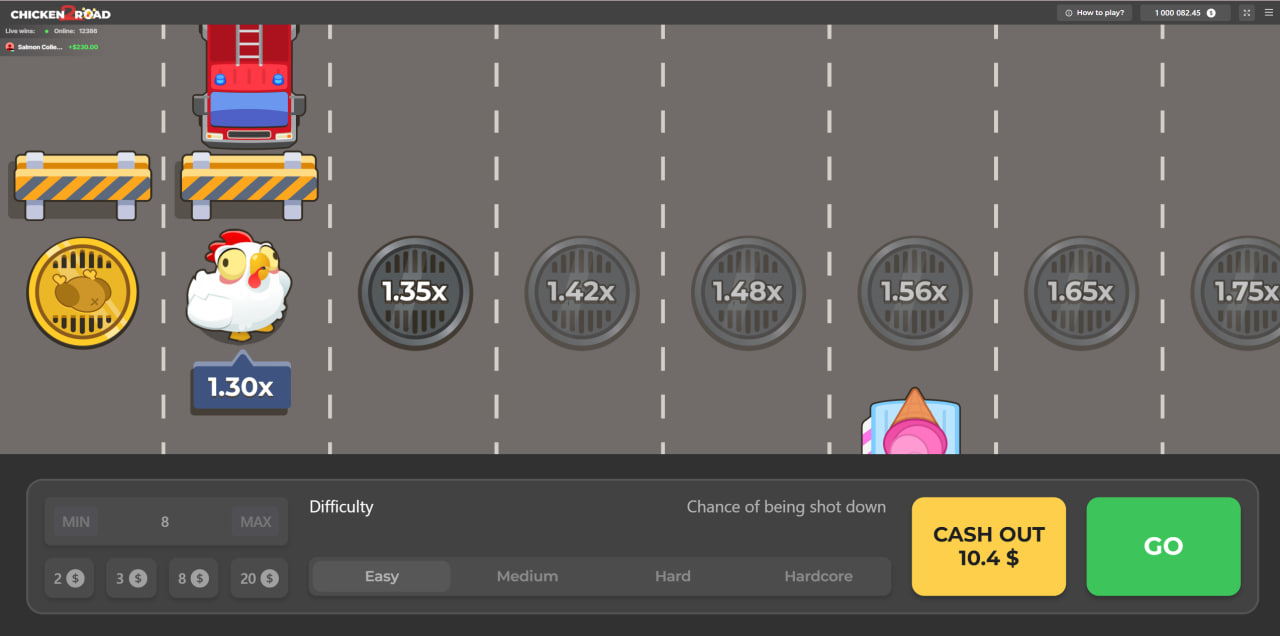
The value of demo play is behavioural rather than instructional. The rules take one round to learn. What takes longer is discovering how you personally react when a run is going well, and whether you actually stop at the point you told yourself you would. Playing several sessions on different difficulties shows how differently Hardcore and Easy behave over twenty rounds, which is far more informative than reading a volatility description.
- Open the game on a platform that offers demo access for the title.
- Select Demo Mode — usually labelled "Demo", "Play for fun" or "Free play" near the game launch button.
- Choose the difficulty and start on a lower setting to observe the baseline pace.
- Start a round and advance step by step, noting how the multiplier progresses.
- Practise the cash-out mechanics by setting a target multiplier in advance and stopping there every time, including when continuing feels obvious.
Demo vs Real-Money Mode
| Feature | Demo Mode | Real-Money Mode |
|---|---|---|
| Real stake | No | Yes |
| Potential winnings | No | Yes |
| Gameplay mechanics | Yes | Yes |
| Financial risk | No | Yes |
| Difficulty settings | Yes | Yes |
| Account or deposit required | Usually no | Yes |
The one thing demo mode cannot replicate is the psychological weight of a real balance. Decisions that feel easy with virtual credits become considerably harder when the accumulated amount is money you could withdraw. Players who cash out with discipline in demo and then abandon that discipline with real funds are experiencing something entirely normal — which is precisely why fixing limits in advance matters more than practising the mechanic.
Real-Money Game
Playing for real money means the same game with actual stakes deducted from an account balance and actual payouts credited to it. The mechanics, RTP and difficulty options are unchanged from the demo. What changes is that every round has a financial consequence, and that consequence accumulates faster than most players expect at higher difficulties.
Availability depends on your platform and location, since the game is distributed to licensed operators rather than offered directly by the developer. Deposit methods, currency, minimum and maximum stake limits, and withdrawal processing all sit with the operator, not with the game.
What changes when you move from demo to real stakes:
- Your balance is real — each round's stake leaves the account immediately when the round begins.
- Wagering limits apply — minimum and maximum bets are set by the operator and may differ from the demo.
- Payouts are credited as withdrawable funds, potentially subject to bonus wagering terms if a promotion is active.
- A maximum win cap applies to individual rounds regardless of the multiplier reached.
- Verification may gate withdrawals even when it was not required to deposit.
- Responsible gambling tools become relevant — deposit limits, loss limits, session reminders and self-exclusion options.
Chicken Road 2 real money is a gambling product with a built-in house edge. Losing the stake is the statistically expected outcome of a round, not an unusual one. Set a session budget you are fully prepared to lose before opening the game, use the deposit and loss limits your platform provides, and stop when you reach a limit rather than when you feel ready. If play stops feeling like entertainment, or if you find yourself playing to recover losses, step away and use the self-exclusion tools available. Support organisations for gambling-related harm operate in most jurisdictions and are free to contact.
How to Start Playing for Real Money
- Choose a suitable gaming platform that is licensed in your jurisdiction and carries InOut Games titles. Confirm the provider tag in the game lobby.
- Create an account with accurate personal details — mismatched information typically causes withdrawal delays later.
- Complete required verification, usually identity and address documents, before attempting to withdraw.
- Make a deposit using a method you control directly, and set a deposit limit at the same time if the platform offers one.
- Open Chicken Road 2 from the game lobby, and check the RTP and limits shown in the game's information panel.
- Set your bet and difficulty, then start with the smallest stake available until you have seen how the chosen mode behaves with real funds.
Strategies and Tips
No approach to this game changes its mathematics. The house edge is fixed, rounds are independent, and no sequence of bets alters the probability of the next outcome. What a considered approach can do is control how quickly a bankroll is exposed and reduce the influence of impulse on cash-out timing — which is a meaningful difference, just not a mathematical one.
- Start with a bet size you would not mind losing entirely, and keep it constant rather than adjusting it round to round.
- Test the game in demo mode first, particularly if you intend to play anything above Easy.
- Use lower difficulty while learning — the slower risk curve gives you more rounds of experience per unit staked.
- Set a bankroll limit before opening the game and treat it as fixed, not as a starting figure to be topped up.
- Decide your cash-out point before the round begins, ideally as a specific multiplier rather than a feeling.
- Size bets as a small fraction of your session budget so that a losing streak does not end the session in a handful of rounds.
- Avoid chasing losses — increasing stakes after a losing run raises exposure without improving odds.
- Avoid emotional bet increases after a win, which is the same behaviour in a more flattering disguise.
- Treat high multipliers as low-probability outcomes, not as targets that become more likely the longer you play.
- Set a session time limit as well as a money limit, and use platform reminders if available.
Discipline around exit points is the only variable genuinely under your control. Everything else — the outcome of each step, the difficulty's underlying probabilities, the house edge — is fixed before you sit down. A player who cashes out consistently at a modest multiplier and one who pushes for large ones are both playing against the same return figure; they are simply choosing different distributions of the same expected cost.
Common Mistakes to Avoid
- Chasing losses by continuing a session past a predetermined limit in order to break even
- Increasing bet size after losing rounds, often described as a recovery system but functioning as accelerated exposure
- Ignoring bankroll limits set before the session began, or quietly revising them mid-session
- Playing past a session time limit when concentration and decision quality have already degraded
- Assuming RTP guarantees short-term returns and expecting a 95.5% figure to apply across an evening
- Taking excessive risk for high multipliers on Hardcore with a bankroll sized for Easy
- Reading patterns into previous rounds, such as expecting a win after several losses
The common thread is treating independent random outcomes as though they were connected. Each round of Chicken Road 2 is resolved on its own terms, and no amount of previous losses makes the next round more likely to pay. Recognising that removes the logic behind most of the mistakes above.
Chicken Road 2 App
Chicken Road 2 is built as a browser-based game, which means mobile play generally works through the same platform page used on desktop rather than through a separate download. The interface was designed with vertical screens in mind: a single primary action button, a fixed control strip and large multiplier text that stays readable at small sizes.
Performance requirements are modest, since the graphics are flat and the animation minimal. Most current smartphones and tablets handle the game without issue in an up-to-date browser. A dedicated standalone app from the developer is not confirmed, and any application claiming to be an official Chicken Road 2 app should be treated with caution — access is normally through the operator's own site or app.
- Smartphones — supported through mobile browsers on current devices
- Tablets — supported, with more screen area for the road view
- Mobile browsers — the standard access route; keep the browser updated for best performance
- Android — playable via browser on modern versions
- iOS — playable via browser on modern versions
- Connection — a stable connection matters, as a drop mid-round can interrupt an active bet
Mobile vs Desktop Experience
The gameplay is identical across devices — same mechanics, same RTP, same difficulty options. What differs is ergonomics. Mobile puts the advance and cash-out controls under your thumb, which suits a game whose entire input is a repeated single tap. Desktop offers a larger view of the road and, on some builds, keyboard input for faster advancing.
Mobile's main drawback is the same thing that makes it convenient: it is always available, which makes unplanned sessions easier to start. Desktop's larger display makes multiplier values and remaining lines easier to read at a glance, which is marginally useful on higher difficulties where steps carry more weight.
| Aspect | Mobile | Desktop |
|---|---|---|
| Screen size | Smaller; interface scaled for vertical view | Larger; full road and interface visible at once |
| Controls | Touch taps, thumb-friendly placement | Mouse clicks, keyboard shortcuts on some builds |
| Accessibility | Playable anywhere with a connection | Fixed location |
| Graphics and interface | Simplified layout, same visual style | More detail visible, wider viewport |
| Convenience | High — instant access | Lower, but encourages more deliberate sessions |
Chicken Road 2 vs Original Chicken Road
The sequel keeps the core loop of the original intact and adjusts the surrounding parameters. Anyone who played the first title will recognise the mechanic immediately; the differences are in setting, scale and the return figure.
| Feature | Chicken Road 2 | Original Chicken Road |
|---|---|---|
| Gameplay | Step-based crossing with manual cash-out | Step-based crossing with manual cash-out |
| Visual design | Highway setting with denser traffic presentation | Original road setting, simpler layout |
| Difficulty options | Four modes: Easy, Medium, Hard and Hardcore | Four modes with the same names |
| Line counts | Reported as higher across all modes (commonly 30/25/22/18) | Reported as lower (commonly 24/22/20/15) |
| Multipliers | Higher reported ceilings; values vary by source | Lower reported ceilings |
| Maximum win cap | Commonly reported at 20,000 in account currency | Commonly reported at 10,000 |
| RTP | Reported at 95.5% | Reported at 98% |
| Mobile experience | Browser-based, mobile-optimised | Browser-based, mobile-optimised |
The clearest trade-off is between reach and return. The sequel extends the path, raises the ceiling and doubles the reported cap, while the reported RTP is lower than the original's — meaning a larger theoretical house edge per unit wagered. Which version suits a given player depends on whether a higher potential ceiling or a better theoretical return matters more to them, and both figures should be verified in-game rather than taken from third-party listings.
Pros and Cons of Chicken Road 2
| Pros | Cons |
|---|---|
| Simple mechanics learnable in a single round | Every outcome is determined by chance |
| Four difficulty modes give direct control over volatility | Higher multipliers require accepting substantially higher risk |
| Demo mode available for risk-free familiarisation | No strategy can overcome the built-in house edge |
| Browser-based and accessible on mobile and desktop | |
| Provably fair verification on supporting versions | |
| Manual cash-out keeps the exit decision with the player |
The honest summary is that the game's strengths and weaknesses are the same features viewed from different angles. Player-controlled risk is genuinely unusual and genuinely useful, and it also makes it easy to select a volatility level that a bankroll cannot support. Fast rounds keep the game engaging and also compress the time in which a session budget can disappear.
FAQ
What is Chicken Road 2?
Chicken Road 2 is a crash-style instant game developed by InOut Games and released as a sequel to the original Chicken Road. Players guide a chicken across a road one line at a time, building a multiplier with each successful step, and choose when to cash out before a collision ends the round and forfeits the stake.
How do you play Chicken Road 2?
Set a stake, pick one of four difficulty levels, and start the round. Advance the chicken forward line by line; each survived step raises the multiplier. Cash out at any point between steps to receive your stake multiplied by the current value. If the chicken is hit first, the round ends with no return.
What is the RTP of Chicken Road 2?
The RTP is commonly reported as 95.5%, with some listings citing 95.51%. That implies a house edge of roughly 4.5%. Because configurations can differ between operators, check the figure displayed in the game's own information panel rather than relying on third-party listings before you play.
Does Chicken Road 2 have a demo mode?
Yes, most platforms carrying the title offer a free demo using virtual credits. The demo runs the full game — same difficulty settings, same multiplier progression, same cash-out mechanic. Whether an account is needed to access it depends on the operator; some allow instant play, others require registration first.
Can I play Chicken Road 2 for real money?
Yes, at licensed online casinos that carry InOut Games content. Availability depends on your location and the operator's licensing. Deposit methods, stake limits and withdrawal terms are handled by the platform rather than the game developer. Real-money play carries financial risk and should be approached with preset limits.
What is the maximum multiplier in Chicken Road 2?
Reported maximums vary widely between sources, particularly for Hardcore mode, so no single figure can be treated as confirmed. More practically relevant is the maximum win cap — commonly cited as 20,000 in the account currency — which limits a single round's payout regardless of the multiplier reached.
How do payouts work in Chicken Road 2?
Your payout equals your stake multiplied by the multiplier value at the moment you cash out, subject to the platform's maximum win limit. Cashing out is manual and must happen before the round ends. If the round ends first, the stake is lost and no partial return is paid.
Can I play Chicken Road 2 on mobile?
Yes. The game is browser-based and runs on current smartphones and tablets through a mobile browser, on both Android and iOS devices. The interface is laid out for vertical screens with thumb-accessible controls. A dedicated standalone app from the developer is not confirmed, so access is usually through the operator's site.
Does Chicken Road 2 have different difficulty levels?
Yes, four: Easy, Medium, Hard and Hardcore. Each changes the number of lines to cross and how sharply risk escalates per step. Lower settings produce frequent small returns; higher settings produce rarer, larger ones. The theoretical return stays the same across all four — only the variance changes.
Is there a strategy to win at Chicken Road 2?
No strategy can guarantee winning or overcome the house edge. Rounds are independent, and no betting pattern changes the probability of the next outcome. What sensible play can do is manage exposure — consistent stake sizing, a predetermined cash-out point and firm session limits reduce how quickly a bankroll is depleted.
Can I cash out at any time?
You can cash out between any two steps while the round is active, locking in the multiplier reached at that point. You cannot cash out partway through a step in progress, and you cannot cash out once the round has ended. Some versions also offer an auto cash-out option at a preset value.